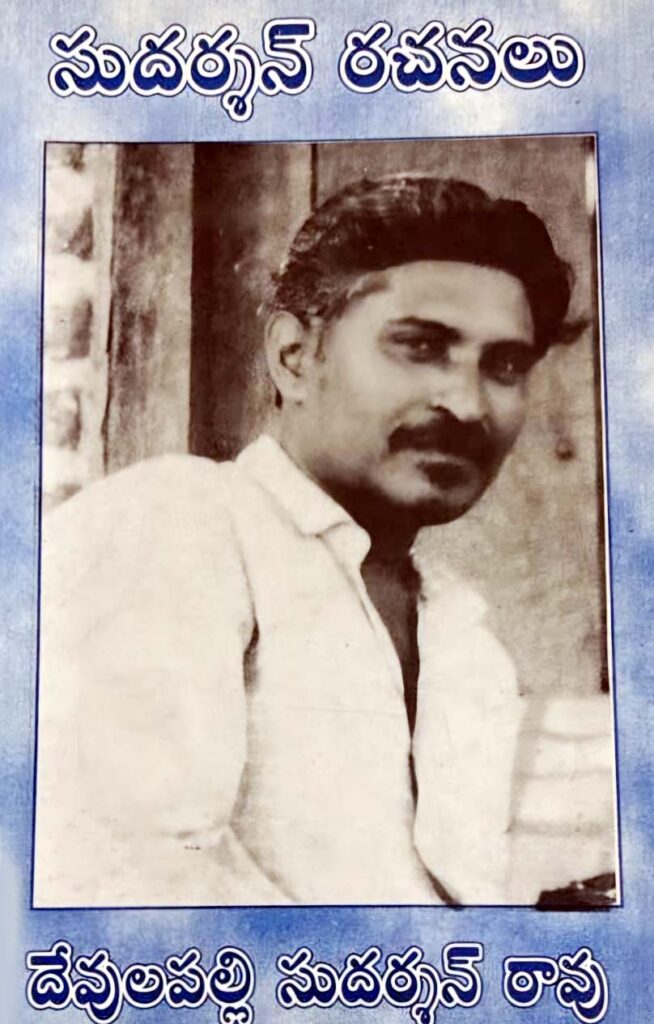
I first learned about Sri Devulapalli Sudarshan Rao, the father of Sri Devulapalli Sarath Chandra, when I was writing a citation of appreciation on the occasion of Sarath Chandra’s retirement. The legacy of such a great poet has given me the opportunity to contribute my words in celebration of the birth centenary of Sri Devulapalli Sudarshan Rao. This occasion has also provided me with a valuable opportunity to explore and appreciate his literary works and poetry. From his collection, I have selected a few poems that particularly appealed to me. Based on my reading and understanding of these poems, I would like to share my impressions of the poet and his work.
For this review, I have chosen two poems from his collection Scribblings and one from his Telugu poetry, Reading these poems has helped me gain a deeper understanding of the ideas and messages he seeks to convey through his poetry and the role he believes a poet should play in society.
In my view, poets can broadly be divided into two categories. Some write poetry primarily to express their personal feelings, emotions, and experiences, thereby establishing their identity as poets. Others look beyond their personal experiences and recognition, using their poetry to reflect on social realities and address the needs of society. While the first group focuses largely on self-expression, the second sees poetry as a means of making a meaningful contribution to society. Sri Devulapalli Sudarshan Rao, in my opinion, belongs to the latter category. His poetry goes beyond personal expression, reflecting a deeper concern for society and its needs.
The poem “Yearnings” explores the themes of artistic freedom, literary criticism, human ignorance, self-confidence, and inner faith. The poet expresses a strong desire to write according to personal conviction rather than for fame, praise, or recognition. At the beginning, the poet invokes the “Mighty Mother,” a symbol of the creative force behind all existence. The poet wishes to remain free from vanity and does not want others to attribute false ambitions to him.The poet’s friends warn him about the dangers of entering the literary world, where some critics are compared to “beasts of prey.” Through this metaphor, the poet expresses his fear that harsh and narrow-minded criticism may discourage writers and restrict their creativity.However, the poet refuses to be controlled by fear. He declares that fear and hatred are not his guiding principles. This demonstrates his determination to preserve his independence and remain faithful to his ideals. The poem then takes a philosophical turn. The poet repeatedly admits that he knows very little about the world and human nature. By questioning his own knowledge and worth, he expresses humility and recognises the limitations of human understanding. In the concluding stanza, the poet makes his purpose clear. He is neither interested in receiving praise nor afraid of facing criticism. Instead, he believes that his inner faith guides him to write, and he willingly follows that inspiration.
“The Revolt of Man”describes a man who has endured centuries of suffering while following traditional beliefs and hoping for an uncertain heavenly reward. Although he has remained faithful and obedient, he becomes increasingly frustrated by the apparent absence of divine justice. He questions the purpose of religious promises, the authority of dogmatic theology, and the expectation that human beings should remain humble and submissive despite their suffering.Eventually, his patience reaches its limit. He rejects passive obedience and demands liberation from the restrictions that have controlled his life. The speaker declares his intention to break free from the limitations of mortality and participate in the reconstruction of the universe. He identifies the human intellect as the driving force behind revolution and progress.
Through the reference to Viswamitra, he challenges conventional ideas about divine power and suggests that the concept of God may reflect humanity’s own thoughts and imagination.
In Devulapalli Sudarshan Rao’s poem “A Prayer to the Lord of the Seven Hills,” divinity, devotion, and social realism emerge as the central themes. The poem is not merely an expression of religious faith; it also reflects a critical perspective that challenges social contradictions, superstitions, and the tragedies that occur under the guise of religious customs and practices. The central subject of the poem appears to be the tragic incident at Tirumala, in which nineteen devotees lost their lives in a stampede at the shrine of Lord Venkateswara, as reported in the newspapers dated 21 September 1967. The poet expresses profound anguish and indignation over the loss of innocent lives when helpless devotees, who visit the temple with the hope of having a glimpse of the deity, perish in the chaos caused by overcrowding. He draws attention to the irony that, while atheists may reject belief in God, they can nevertheless approach life through rational thought, whereas theists often remain entangled in blind faith and ignorance. The poem also explores how devotion to God has become intertwined with poverty, miserliness, and the growing desire for fame and public recognition. Referring to the tragic incident of 21 September 1967, the poet questions the failure to ensure safety in the very presence of God and condemns the lack of proper crowd management that resulted in the deaths of innocent devotees. While worshippers were losing their lives, the poet challenges both the silence of the deity and the indifference of the authorities. With striking directness, the poet criticises priests who earn their livelihood in the name of God, religious propagandists who employ their clever devices to manipulate the faithful, and rulers who use the name of God to conceal their own failures. He poignantly laments that the deity remains as unresponsive as a stone, seemingly unmoved by the suffering of those who seek divine grace. The poem ultimately questions a form of devotion that, instead of offering solace and spiritual fulfilment, becomes associated with the loss of human lives. It serves as a powerful mirror reflecting the anguish of the common people, caught between the commercialisation of religion, the indifference of those in power, and the insecurity that pervades their lives. Through this incisive critique, Sudarshan Rao urges readers to look beyond blind faith and religious ritual and to recognise the paramount importance of human life, reason, and social responsibility.